One of the biggest mistakes Dentists make is investing thousands in a new website and not thinking about how to get it seen.
Without an ongoing promotion plan, your new website will sit there, looking amazing but not being seen by potential new patients.
So, what’s the answer to this problem?
Well, the good news is you have lots of options. Just looking at online methods for promotion you have numerous social media channels, pay-per-click (PPC) advertising on Google and Bing, digital PR, and SEO.
And it’s SEO we’re focusing on in this article, more specifically, local SEO.
For those wondering, SEO is a tactic used to show up when potential patients search on platforms such as Google for the treatments you offer. Local SEO is a subset of this that focuses on searches tied to a specific location.
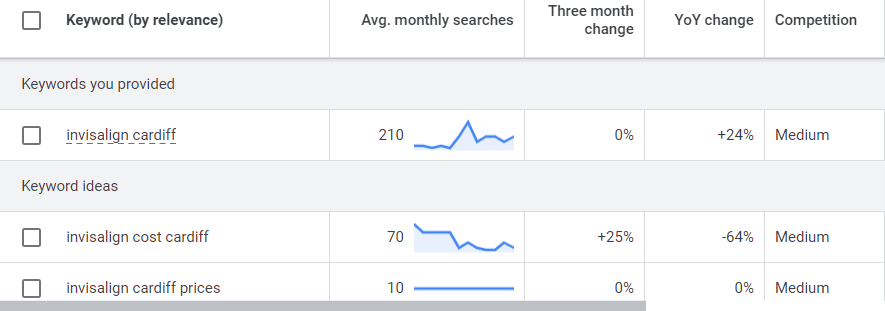
For example, “Invisalign Cardiff”.
Looking at this example, we can see that there are 300 monthly searches for this keyword (search term) and a couple of related phrases.
That’s a lot of potential new business for your dental practice!
Let’s look at how you can capitalise on this opportunity and dominate local search results.
Local SEO tips for Dentists
Know your audience and your expertise
Before jumping in and writing all sorts of content to try and show up for all things Dentist, think about the main treatments you want to be found for.
More often than not these are high value cosmetic treatments like our Invisalign example.
The bad news is, all your competition also want to rank for these too.
Focusing on your priority treatments will help maximise resources and ensure you can outperform your competition.
Once you’ve established good results for your priority search terms you can broaden your activity.
As well as knowing what you want to rank for, it’s super important to understand the audience for these treatments.
Think about:
- What motivates them to want these treatments
- What are their attitudes and behaviours
- Where and how do they research these treatments
- What are the key things they’re looking for
- Demographics
- Locations
Local keyword research
So you know your audience and what you want to promote.
Now you need to find the keywords you want to be found for. These are the phrases people are typing into search engines.
When it comes to local SEO for dentists, all your keywords should be centred on the locations you serve.
So a Dentist in London might target terms like…
Invisalign London, teeth straightening London, invisible braces London, best teeth straightening London, best way to straighten your teeth
Each keyword will have a different search volume (number of searches per month) and varying levels of competition.
The trick is to find keywords you have a chance of ranking in the top spots for.
You can do this with free tools such as Google keyword planner or with paid software like SeRanking, Semrush, and Ahrefs.
Content planning and creation
With your keyword list at the ready you can now focus on the content you’re going to create to target each term.
Firstly audit existing pages to see if any can be optimised for the search terms you identified.
If you don’t have anything relevant you can create new web pages targeting these search terms.
Some tips for creating local SEO content:
- Match the intent of the search term with the content you create.E.g sales focused content for commercial terms, educational content for informational terms.
- Factor in the key selling points you identified when mapping out your audience needs (our first tip)
- Dont try and target multiple locations on the same page.
- Even though you’re targeting search terms don’t overuse them on the page. Focus on key areas such as the main heading and use some variations throughout. Overall context and intent is more important.
- Research the competition for your search terms and look to improveon what the top results are providing
Link building
Links from other websites back to yours act as a vote of confidence in the eyes of search engines like Google.
Relevance and quality matters here.
Admitedly this is hard task when you’re a busy Dentist or Practice Manager but where possible look for opportunities to get links back from relevant websites that operate in the same location as you.
One way you can do this is review the content you create and brainstorm ideas of related content that other businesses might write about. Then approach them highlighting how your content could add value to theirs.
For example…
So if you’ve got articles on the best ways to straighten your teeth or the proper technique to brush your teeth, perhaps you could reach out to local photographers who are writing about capturing the perfect portrait.
Or maybe there are physiotherapists talking about treating sports injuries, and you have an article on your dental implant treatment.
Google Business Profile
We’ve taken a look at some tips to help you optimise your dental practice website, now we’re going to outline some top tips for optimising your Business Profile on Google.
Your Google Business Profile is an essential element of your local SEO efforts.
What is a Google Business Profile?
This is how Google describes them…
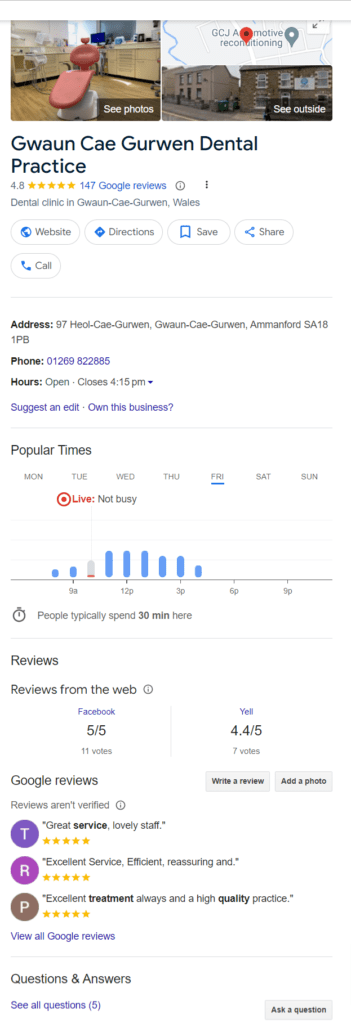
With a Business Profile on Google, you can manage how your local business shows up across Google products, like Maps and Search. If you run a business that serves customers at a particular location, or you serve customers within a designated service area, your Business Profile can help people find you. Verified businesses on Google are twice as likely to be considered reputable.
With a Business Profile, you can:
- Maintain accurate information about your business online
- Tell Google your hours, website, phone number and location (a street address, service area or place marker, depending on your business).
- Use Google Maps and Search to stay up-to-date with your online presence wherever you are.
- Interact with customers
- Post photos of your business and its products and services.
- Collect and respond to reviews from customers.
- Attract new customers
- Improve how your business appears online so that new customers can find you.
- Point customers to your website.
Source: https://support.google.com/business/answer/6300665?hl=en-GB
Tips to improve your Google Business Profile
Firstly if you don’t have one, create a Google Business Profile for your dental practice right away! Then, as a starting point look at doing the following:
- Add your opening hours and services
- Create multiple GBP locations (where applicable)
- Ensure you optimise GBP categories
- Consistently add photos (they’re great for CTR)
- Collect consistent reviews
Local SEO on social media
As well as searching on sites like Google and Bing, there is a growing trend of people searching on social media platforms.
Now more than ever it’s essential that your SEO and social media activity are coordinated and working together.
Each page you create on your website targeting a local dental search can be repurposed into multiple social media posts targeting the same terms.
We recognise the importance of this approach and now offer it as part of our dental marketing plans.
Tips for measuring your local SEO success
So, if you’ve implemented some of the tips from this post, how do you know if they’ve worked?
There are a number of tools you can use to track the performance of your local SEO.
Most SEO’s use SEMRush, Ahrefs, SERanking of similar tools for both keyword research and performance tracking. However, these might be overkill fo your needs.
Our top tip for tracking SEO performance is to set up a Google Search Console profile. This will show what pages are indexed in Google, the keywords they are showing for and the positions you rank for each term.
Then, you can use website analytics software like Google Analytics to track the onsite performance of your search engine traffic.
FAQs
Should I focus solely on local keywords in my content?
In a word, no. Your overarching SEO strategy should incorporate a mix of local and broader industry terms. However, we always recommend starting with the local targeted commercial terms and building up from there. Once you’ve created your local content you can then target broader terms and internally link to your local content.
For example, you might have a page targeting “root canal treatment in Liverpool”, then create a broader targeted page on “how to prevent tooth decay” that links the page to your location page.
How often should I create new local content?
Large batches of content are generally better when it comes to getting SEO results. However, this isn’t always financially viable for Dentists taking their first steps into investing in SEO.
So we’d say a good rule of thumb is to aim for one post a week and support this with related social media content.
Is it necessary to hire a professional SEO to run my local search campaigns?
No but it might be a better investment and use of your time.
On the whole, SEO is a simple tactic – find keywords, create content, find links and promote.
However, there is a lot of skill and nuance needed to make the right decisions at each stage. Plus, competition is fierce, so your output needs to be the highest quality possible.
When you’re a busy Dentist or Practice manager, ask yourself if you have the time to learn about and execute a profitable local SEO strategy.

Hey! I’m Matt, Founder of Brandspace Healthcare. I have 20 years of marketing experience and love working with ambitious healthcare professionals to promote their treatments and provide better customer service online. I’m your main point of contact for every project we work on.

